Thursday, February 12, 2015

Madang Lions Club donate to Modilon ward


Patrick Matbob
Madang Lions and hospital executives with the donations.
5 November 2014

The newly established Madang Lions Club today donated K1, 400 worth of goods to the physiotherapy ward at the Madang General Hospital.
 The items donated included chairs, stools, a large floor fan, a table, a hot water urn, buckets and mops and other items much needed by the ward.
Madang Lions President Joseph Natera said the club which was formed in May this year adopted the physiotherapy ward and this was the first of many donations it would make to help the ward.
He said Lions club members held a ‘walk for life’ walkathon early this year to raise the money to buy the items.  
He said that Lions is planning to bring up a work crew from its sister clubs in Australia to renovate the ward and funds are being raised for that purpose.
A Madang Lions member who owns a company has also agreed to fix the bed used for treatment of patients in ward and to provide screens on the windows. Another Lions member will fix the electrical switches in the ward.
Officer in charge of the physiotherapy ward Hugh Saweni was grateful for the donation saying it would help to ease some of the hardships faced by the staff.
Chief Executive Officer of Modilon Sr Christine Gawi also thanked Lions for the donation. She said this year the hospital management decided to engage community groups to adopt each of the wards at the hospital. She said the idea was to make the community responsible for the hospital which was there to serve them.
She said another charity organization Rotary has also adopted a ward, and she was aware of other groups who wanted to assist as well.
Madang Lions is also in the process of trying to get tax exemption so that it can import medical equipment for the hospital.
Madang Lions has 42 members and welcomes any person who would like to join to assist in community projects.
Ends

100th anniversary of WWl, the battle of Bitapaka


By Patrick Matbob
Bitapaka War Memorial
ON July 23 each year PNG observes Remembrance Day commemorating those Papua New Guineans and foreign troops who fought and died in World War ll.
Yet many Papua New Guineans may not be aware that the First World War was also fought in PNG – in one battle at Bitapaka in East New Britain. In August this year, it will be the 100th anniversary of WWl when Britain declared war on Germany and by doing so committed the members of the British Empire which included Australia and New Zealand, to join the war.

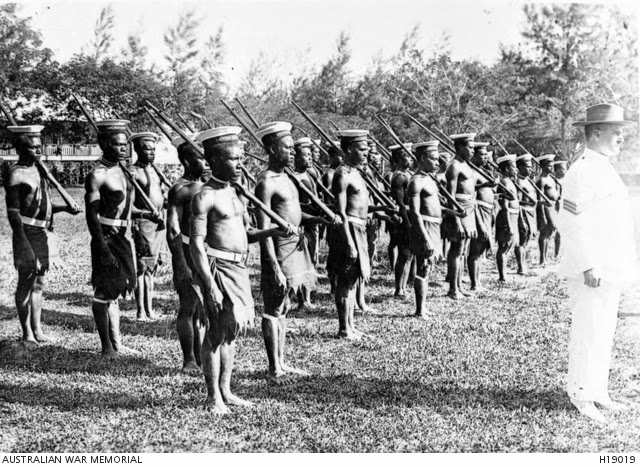
The native constabulary, formerly of German New Guinea.
PNG then was divided, its southern territory of Papua being a British protectorate while New Guinea was under German control. Australia and New Zealand as members of the empire were required to help Britain to fight against the German empire which included areas within the Pacific. Australia put together and trained the Australia Naval and Military Expeditionary Force (AN&MEF) of 1,550 men who were sent to New Guinea to destroy German wireless installations. These force included a battalion of regular infantry, six companies of naval reservists, a signals section, two machine gun sections and an Army Medical Corps detachment. The force sailed for East New Britain on the armed merchant cruiser HMAS Berrima on 18 August 1914 escorted by battle-cruiser Australia and light cruiser Sydney. Other battle ships accompanying them were the cruiser Encounter, and torpedo boat destroyers Parramatta, Warrego and Yarra.
The German ‘force’ that the might of the Australians were up against was actually weak with a number of reserve officers and men in the outstations of the German colony. The force consisted of two regular officers Captain K.G.A von Klewitz and Lt G.A. Mayer, seven reserve officers, 52 white non-commissioned officers and soldiers and about 240 Expeditionary troop and police troopers from outstation detachments.  Majority of the troopers were Papua New Guineans.
After arriving in East New Britain, the Australians landed two parties of naval reservists at Kabakaul to capture the Bitapaka radio station. While trying to locate and destroy the wireless station at Bitapaka, one of the party came under fire from a German force that was made up of 60 Papua New Guinean troopers under the command of eight German reservists. This short but savaged clash entered the annals of history as the battle of Bitapaka.
 For the Australians, this battle may not be as significant as the battles their soldiers fought in Middle East and Europe such as Gallipoli, yet it is notable for the following reasons. It is Australia’s first ever battle in World War 1, and she also suffered her first ever war casualties when two Australian officers and four seamen were killed. For PNG, the local troopers who were then fighting for their German colonial masters became the first and only Papua New Guineans to participate in World War 1 and were most likely responsible for inflicting the Australian casualties.
The Australian force landed at Kabakaul on the morning of September 11, 1914 and proceeded to capture the German wireless station at Bitapaka. However, they were fired upon by German troops made up of PNG policemen under the command of German reservists. The Australians sent for reinforcements as they were pinned down by the PNG snipers high in the coconut trees. The first Australian casualty was Able Seaman William Williams from Northcote who was mortally wounded in the stomach. A member of the Australian scouting party Bill Kember attended to Williams despite the shooting and dragged him back for medical help. An army medical officer Bill Pockley attended to Williams and directed Kember to take him back to the battle ship for necessary medical attention. Pockley gave his Red Cross brassard to Kember to protect them from possible ambush. Williams was successfully moved to the ship, however, Pockley was later shot when he was attending to another wounded soldier. Pockley was moved to the ship, but later both Williams and Pockley succumbed to their injuries and were taken ashore and buried at Kabakaul. They became the first Australian casualties in World War 1.  Finally, the Australians were able to overpower the German forces and take the Bitapaka wireless station.  And at the end of the battle, six Australians were killed and five were wounded. Of the defenders, one German officer and 30 Papua New Guineans were killed.  The manner in which most of the Papua New Guineans were killed remains unexplained to this day. Some records show that the German officer and the 30 policemen were not killed in battle but were captured and were later bayoneted to death by the Australians.  No reasons are given why they were killed in such a manner.
The battle of Bitapaka was the only armed resistance by the Germans in New Guinea and on 17 September 1914, the terms of capitulation were accepted by Germany and Australia was now in military occupation of German New Guinea. Detailed description of the Battle of Bitapaka is available on the Australian War Memorial https://www.awm.gov.au/histories/first_world_war/AWMOHWW1/AIF/Vol10/ site.

A Marist's love affair with PNG


By Patrick Matbob

Arriving for the first time in PNG in 1966, Marist religious brother Patrick Howley felt he had come home. He immediately fell in love with country, and found that the environment suited his lifestyle.
“I found the place very convivial. It sort of suited my way of life”, Br Pat, as he is known by all who have come across him, said. 
“I felt that I was good for Papua New Guinea, and at the same time, Papua New Guinea was good for me”.
He felt so much at home in PNG that soon after independence he became a citizen wanting to die and be buried in the country.
Br Patrick Howley, Marist.
“I wanted to string it out as long as I could and I was sort of preparing to die with my booths on,” said the 88-year-old in a final interview before leaving the country in May this year.
However, circumstances would compel him to resume Australian citizenship in the 90s.
He had come in 1966 at the age of 40, an energetic and fiercely independent individual, unafraid to challenge the norms of the colonial education system, and even his own religious rules, while having a deep appreciation and understanding of the local people he was helping to educate. Never afraid to experiment, his methods were often unorthodox annoying or amusing his professional and religious superiors. Yet he seemed to thrive on challenges, and his accomplishments were unique, such as his method of democratizing the schools under his control by introducing the Ombudsman and government systems.
He was a striking figure back in the early years, his balding head hedged in by snow white mane that extended down the back of his neck. A neatly trimmed white beard and moustache adorned his aquiline features, completed by thick-framed spectacles. He looked more like a 1950s movie star than a religious educator.
When he joined fellow Marist missionary teachers in PNG, he had been teaching in Australia for 19 years and finding it very stressful.
“It was the time of the baby boom and the classes were very large and I was working very hard, the government was paying no money for the Catholic schools to run so we would operate on a shoe string, and life was pretty difficult,” recalls Br Pat.
Arriving in PNG, he found the country and the people much to his liking. The predominant subsistent farming lifestyle of the Papua New Guineans he came to live amongst suited him. It was the same lifestyle that he was raised in back in Australia after his family lost their sheep farm in the depression.
 “Arriving in PNG and meeting the new subsistent farmers here, I had a lot of feeling for them, a lot of understanding. I fitted in rather well. I was able to sympathise and understand their attitudes much more easily than some of the others who come up here. ”
Br Pat with Sir Michael in the 70s.
He settled in at St Xavier’s high school on Kairiru and soon found that there was a basic difference in the culture between the kids that he taught in Australia and those in PNG.
“Kids were very unwilling to expose themselves to taking risks and making mistakes. It was a very powerful cultural thing”.
He tried various ways to break the culture.  A unique method he pioneered was to introduce the parliament and student disciplinary system run by students themselves at St Xavier’s to develop responsible leadership among the students. He did this because the approach to discipline in PNG schools was authoritarian and he saw that that did not help students when they left school and had to depend on themselves. He organized student group leaders to be in charge of things like sport, transport, social affairs, and even finance. The disciplinary system had an Ombudsman for the protection of students against each other and staff. Br Pat said the parliamentary system quickly pushed elected student leaders out of their comfort zones.
“They treated any criticism of proposed policies as personal and wanted to resign. They resorted to the famous Melanesian passive resistance, which operates by doing nothing and failing to cooperate. But resignations were refused and staff pulled the students together. Gradually they gained confidence and improved”, he said.
The education authorities did not like what he was doing and his school inspector Neal Murray told him so. Br Pat ignored him.
St Xavier’s became one of the first high schools in PNG to introduce Grade 10s (Form 4) at the time and Br Pat recalls potential employers and institutions flocking to the island to recruit students mainly because they could speak English.
Being an island school, transportation was a regular problem. Br Pat organized for funds to be raised in Australia and a 33-feet De Havilland barge was bought to ferry students and cargo to the island. Islanders chose to name the vessel Tau-K, Tau being the local name for Kairiru and ‘K’, they insisted, was for St Kristopher, the saint for travelers. Purchasing the vessel, the school needed a wharf. Br Pat rolled up his sleeves and with the help of his students and brothers, built a wharf out of coral and river stones that were collected.
Francis Mahap, currently a lecturer at DWU was one of the students who helped build the wharf. We would all strip down and jump into the sea to remove the corals, Mahap recalls.
For the first five years after coming to PNG, Br Pat did not return to Australia for holidays like other brothers. Instead he would go into the rural areas of East Sepik, travelling on the Sepik River, to villages and mission stations and spending his holidays there. He learnt a lot about the people’s way of life by living and eating with them.
Later he demonstrated this understanding of the local people and cultures in many ways. For instance, when St Xavier’s was having land disputes with locals, Br Pat dealt with the problem as a local would. He went into Wewak and bought a carton of beer then visited old Kapun, the chief of the nearby village and invited him over.
“I’ve got a carton of beer up there. Will you come up and help me to drink it?” he said. “We drank the beer until we were both absolutely stonkered. We told each other what wonderful fellows we were, and what wonderful people the Kairiruans were. We told all the old stories. Kapun went off happy. There was never any trouble over the boundaries for another three years.”
Br Pat says the land boundary dispute was happening because they were not providing the people with the relationships that they needed.
“Kapun needed the opportunity to argue about the land and talk about the land, because it is a verbal society, not a literate society. Whenever a land problem arose again, there would be another carton of beer. It was a question of establishing relationships. If your relationships are good, everything runs sweetly. If the relationships are bad, nothing runs. That is vital to any understanding of Melanesia”.
In 1977, Br Pat returned from holidays in Australia and got a surprise appointment. He was asked to become principal of the new Passam National High School which was being established. Passam had problems with incomplete infrastructure and the appointed principal had resigned. Education inspector Neal Murray told Br Pat: “As Inspector I know that you have the toughness and resilience to make a go of it”
Br Pat took control of the situation. He gathered his staff members and together they decided on what sort of students they wanted to produce at this pioneering institution. Aware that they were not getting the cream of PNG graduates which were snapped up by other national high schools, the expectations were moderate.
“Our preference was a friendly student who related well with others and the staff,” he recalls. Another unusual and controversial thing they did was to do away with all school rules. He said they wanted to avoid the ‘them (staff) and us (students)’ situation. They finished up with four school rules.
1.      Student must attend school
2.      Student must take their share of work parade
3.      The school motto: Nuo Yekende, m’ne Yekende meaning I must respect myself and I must respect others.
4.      Students must use their common sense
The education authorities did not like what they had done, and advised them to make a list of expellable offenses. Br Pat responded that expellable offences were criminal offences any way, and if the education authorities failed to enforce any of his decisions, he would take it to the courts. They did not like this either.
At Passam, Br Pat introduced the Ombudsman to deal with student and staff issues but not the Parliament system. Again he worked on improving relationships with the surrounding communities by holding a special meal twice a year for the leaders of the villages. But not everyone was satisfied and Br Pat says he was told later by a villager that they had ‘made poison sorcery against him five times’. The villagers were disappointed that he did not die.
An interesting sorcery case he had to attend involved a student from one of the Highlands provinces. Br Pat was told that a sorcerer had ‘poisoned’ one of the students. The students said they knew about this because the victim looked sick and had not reacted when they stuck a needle in the back of his neck. Br Pat reacted quickly by approaching a local villager who had a reputation as a sorcerer and he agreed to help.
“He went inside his house came out with a rather dirty looking glass; put some water in it; scraped some bark from a tree nearby; and called his five-year-old son to come and piddle into the glass”. Some of the mixture was poured into the student’s mouth and after about 20 minutes, the student began to vomit and his eyes and face changed and he was not sick any more.
“When we asked him, what had happened he explained that four men had been walking along the road and with a gesture had immobilised him. They took him into the bush and told him that he was to return on Sunday afternoon and that he would be dead on Monday morning”.
Br Pat says that the friendly sorcerer had broken the chain of sorcery that leads to death.
After Passam he joined Divine Word Institute and in 1987 introduced the cultural day which is now an annual event.
Br Pat made his greatest contributions on Bougainville during the crisis when he went there in 1994 to run a course on conflict resolution. On Bougainville he ran a number of courses for the people and met John Tompot from Siwai who attended one of his trainers course. Br Pat found that John had been doing conflict resolution using the traditional methods he had learnt from his ancestors.
“When he described how he had satisfied the parties in a murder case, I knew that we had found the ancient restorative justice process. What I had suspected, restorative justice proved to be the true ancient process of conflict resolution in Melanesia”.  He scrapped the personal development section of the course he had been using and adopted the restorative justice process that he learnt from John.
Working on Bougainville, he needed the permission and assistance of the PNG army and found Walter Enuma and former PNGDF commander Jerry Singirok cooperative and helpful in the work he was doing.
“During the years, I saw quite a lot of Walter and found him a good soldier and possessed of sound common sense”.
With Singirok and Enuma’s support and help from local chiefs and people, the peace program was being implemented with success as far as Buin on the south. However, Br Pat says when the military replaced Enuma with another officer, the peace efforts broke down again eventually resulting in the Kangu beach massacre. He captures his Bougainville experiences in his book Breaking Spears and Mending Hearts published in 2002.
The Foundation also contributed to work of restoring peace in parts of PNG such as in Gulf and Central provinces. It was while working in Central Province that he met Sinaka Goava, a member of the Foundation, who asked him to help write a book about his father – Goava Oa. The book Crossroads to Justice: The life of James Goava Oa and Sinaka Goa was published by DWU Press in 2007. It is a powerful story outlining the injustices suffered by two Papua New Guineans at hands of the colonial masters who regarded native people as savages, deficient in intelligence and trouble makers.  
Br Pat spent his last 10 years in PNG at DWU teaching restorative justice and conflict resolution in the Flexible Learning Centre.  In 2016, he would have clocked up 50 years in PNG. He had stayed as long as he could in the country he loved defying his ailing health and superior’s directions to retire to a retirement home in Australia. Finally, this year he struck a deal with his superior and moved to the Marist old people’s home at Ashgrove in Brisbane.
He smiled while recounting his superior’s words. “I will make you a deal. If you have to come south and you die in Australia, I’ll have you cremated and send the bones back and we will bury the rest of you in PNG”.
“I said that’s a deal”, says Br Pat with a twinkle in his eyes. “Actually it doesn’t mean a great deal because when I die, I die, and God is not fussy whether I am buried here or there or anywhere else”.

Sunday, December 15, 2013

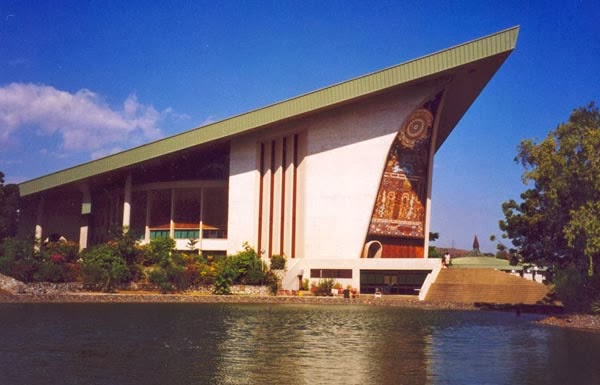
Stop desecrating our Parliament


Stop desecrating our Parliament

By Patrick Matbob

It does not matter whether the decision to remove the traditional objects was taken unilaterally by the Speaker or that he was implementing a committee’s decision. The committee’s decision is wrong. Priest, author and teacher, the late Fr Frank Mihalic had this definition for the word committee – it is a group of the unqualified, put together by the unwilling, to do the unnecessary.

We, Papua New Guineans, have to constantly remind ourselves that our country is not a naturally forged nation. PNG is not made up of a single race of people, nor culture, language, religion or any common experiences. We do not even have a shared experience such as a war that would have brought us together. PNG is the nation of numerous tribal groups, languages, cultures brought together by colonial powers for their own interests. We are in reality an artificial nation and our biggest challenge today is to stay together as a country. This is the reality for the founders of our country when they created PNG. They wanted PNG to be a nation that would be united within its diversity.  In order to ensure the diversity existed, symbols and representations of our differences were deliberately sought and encouraged to be used to emphasise the rich diversity that was being united. The Parliament is a great icon of this reality as it encompasses PNG’s diversity as much as possible in the cultural symbols in an effort to unite us.

We are told that the cultural objects in Parliament are being removed because they are evil and unchristian and somehow responsible for the poor behaviour of our leaders. Religious arguments are complex because they depend on religious teachings and interpretations that vary. Yet the act of removing cultural objects based on Christian beliefs is a vain exercise. It is like trying to create heaven on earth, in this case, a heaven in Parliament devoid of all earthly beliefs and influences so that the Parliament is clean and pure. It is impossible. What about the hearts of our leaders which is really where the roots of all good and evil lie. It is us humans who decide in our hearts to commit the good or the evil – and we do so using our bodies and the laws and many other cultural objects that we have created – money, valuables, alcohol, drugs, weapons, art, music, etc. Did not Jesus rebuke the leaders in his time calling them hypocrites because their hearts were impure? “… You are like white-washed tombs beautiful in appearance, but inside there are only dead bones and uncleanness (Matt: 23: 27).” The cultural symbols in Parliament are evidence that our ancestors’ were spiritual people and were in a quest to discover God long before the arrival of Christian missionaries.  When the first missionaries arrived, they realised that the people had strong traditional spiritual beliefs. Early missionaries banned many evil practices such as cannibalism, sorcery and witchcraft and introduced Christianity. They also realised there were many valuable cultural practices essential to maintaining the well-being of a society and allowed people to continue practicing their cultures. For instance a quote from the early Divine Word Missionaries in Momase region – the missionaries were trained never to tear down a culture but to study and appreciate it, use its good points and whenever possible to baptise the rest of it. Thanks to early missionaries like them we still have bride price payments, initiation rites that train villagers how to live together, and the knowledge of art and crafts essential to daily living such as making canoes, houses, gardens, songs and dances, etc.  

We need our cultural symbols for they are of value to us to stay together as a nation. There have been actions by missionaries in the past to exterminate the cultures of people they encountered in the belief that they were making them fully Christians. Instead they only succeeded in dressing them up in white clothes to look like Europeans! The result has been a complete disaster and certain societies such as the Australian aborigines and former slave colonies are still trying to establish their identities today.

 So far people supporting the removal of cultural artefacts have not said how these objects are influencing the leaders and responsible for the problems happening in Parliament. They are putting forward arguments without any evidence and accusing and condemning others of idol worship and quoting scriptures that are taken out of context. Where is the evidence that idol worship is happening in Parliament? Are there cult groups or activities within Parliament where the objects are worshiped? How is this happening? We are aware of and have evidence of cult activities in our schools in PNG but there is no evidence whatsoever from the Parliament house.

Most of the objects within the Parliament were carved in Port Moresby at the National Arts School by artists brought from different parts of PNG. I am not aware of any cultural ceremonies held to dedicate these objects to spirits they were supposed to represent. The only ceremony we are aware of was the official opening of the Parliament in August 7, 1984 by Prince Charles representing the Queen as head of the Commonwealth.

The act of blaming cultural objects for our problems in Parliament unfortunately reflects the reluctance of our people to admit and accept that our leaders are human and weak and can do wicked things as well as the good they are expected to do. Are we not looking for scape goats for the sins of our leaders? We must also realise and accept that our Parliament system is new, and is going through changes which can have some upheavals like the recent political impasse. That does not necessarily mean our leaders are under some evil influence. It means we are looking for ways to make our Parliamentary democracy system work in harmony with the changes that are continuously happening in PNG today.

The cultural objects at the Parliament represent our cultural heritage which embodies our identity. Our identity is important as we develop in the modern world because it helps us to know our place in society and how we have come to be where we are. Without this knowledge we are open to being exploited and abused by powerful organisations that we come into contact with today. Our identity is also our history, which is important as we move forward that we do not repeat the mistakes of our ancestors.

The action of the Speaker and his committee also demonstrates a lack of respect and contempt for our past leaders and elders in Parliament. This ‘holier than thou’ attitude of casting stones at others is not healthy for us and is not the teachings of Christ. One of the homes of dying used by Mother Therese of Calcutta was an old Hindu Temple where Hindu gods were worshipped. This was of absolute no concern to her as she knew God’s love transcends races, religions, cults, beliefs, etc. Majority of those she cared for were not Christians any way. Jesus gave few key commandments: to love God and neighbour, and made it clear that on judgement day there were will be particular questions asked: When I was hungry,  when I was thirsty, … when I was sick and in prison … etc. So instead of defacing the Parliament, what are we doing for our people, women and children who hunger and thirst not only for food but for love and justice, who die of curable diseases, or imprisoned for committing crimes to survive?  

It is for these reasons that we should be careful with what has been happening at the Parliament. When we remove the cultural objects, what are we really doing? Are we really cleaning up the Parliament and the actions of our leaders? I think not.  We are removing the objects and symbols that help to bring us together as a nation. If we are not careful we could be dismantling PNG.

Saturday, December 7, 2013

School on global link

Talidig first in the world to establish link

 
By Patrick Matbob

A primary school in Madang has become the first school in the world to go on the Global Education Partnership program.

Fairweather and Sir Arnold establishing the link
Talidig Primary school which is situated about 45 kilometres north of Madang was chosen to participate in the Global Partnership program that is being run by British volunteer organization Volunteer Services Overseas (VSO). The program is aimed at linking schools in Britain and the world.

To participate in the program, the school also became one of the first few local primary schools in the country to be given computers and an internet link with the outside world.

The event was launched two weeks during the school’s graduation day and was witnessed by the Madang province governor, the local Parliament member, government officers and hundreds of parents, teachers and members of the local community.

 School head teacher Peter Igubi was the proudest person on the day.

“I am very, very proud. I’ve never come across such a project in my 34 years of teaching”, he said visibly moved by the development at his school.

VSO volunteer heading the project Roger Colborne said under the program Talidig primary will link with Ludworth primary school in County Durham in England.

Preliminary contact has already begun between the two schools and with the internet installed regular contact will began in the new school year.

Major funding for the establishment of the project came from the electoral development funds of the member for Sumkar Ken Fairweather in whose electorate Talidig primary is situated. Mr Fairweather gave K123, 000 to establish the facilities at Talidig and Tabel primary schools on Karkar island which will become the second school involved in the project.

Eight computers were donated by Rotary Club in Madang for the program while the British High Commission funded a laptop projector, printer and other consumables.

Madang Governor Sir Arnold Amet told the parents that his government has made a commitment to provide computers to all the primary schools in Madang. He said this was part of his plan to ensure that all children in the province were able to attend school and to have access to the best learning facilities.

He said at the moment his government’s biggest challenge is to ensure that all school-age children in the province are able to attend school, and that there is enough schools, teachers and resources in the province.

Headmaster Mr Igubi said the establishment of the computer facilities was a good opportunity for teachers and students to learn computing for basic education.

He said all the children in the school will have the opportunity to ‘touch and use’ the computers and will establish e-mail contact with Ludworth children in UK.

ends.